
The chalaza is the small white, rope-like strand often seen attached to an egg yolk. It may look unusual, but it is a completely natural part of the egg and plays an important role.
Many people assume it signals a problem, such as spoilage or fertilization. In reality, it is neither harmful nor unusual. In fact, the presence of a visible chalaza can indicate that an egg is fresh.
The chalaza is a twisted strand of egg white (albumen) that anchors the yolk in place. Each egg contains two of them: one on each side of the yolk.
Advertisement
Its function is to keep the yolk centered within the egg, preventing it from moving freely and protecting it from damage. This natural structure helps maintain the integrity of the egg.
It often draws attention because it looks different from the rest of the egg. While the egg white appears smooth and uniform, it’s thicker and more cord-like.
Despite its unusual appearance, it is simply a denser portion of the egg white that has formed into a twisted strand. It is a normal and expected feature.
Advertisement
Common Myths About the Chalaza
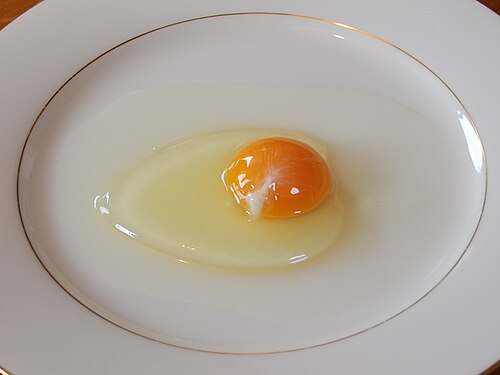
By miya – miya‘s own file, CC BY 3.0, Link
Because of its appearance, it is often misunderstood. Several common myths persist:
Myth #1: It Is an Umbilical Cord
It is not related to embryo development. It has no connection to a chick forming inside the egg.
Myth #2: The Chalaza Means the Egg Is Fertilized
The presence of a chalaza does not indicate fertilization. All eggs, whether fertilized or not, contain chalazae.
Myth #3: It Should Be Removed
It is completely edible and safe. It does not affect the taste or safety of the egg.
Advertisement
It can provide useful information about egg freshness.
In fresh eggs, it is typically firm and clearly visible, holding the yolk tightly in place. As eggs age, the egg white becomes thinner, and the chalaza weakens and becomes less noticeable.
A prominent chalaza is often a sign of a fresher egg.
Fresh eggs have a thick egg white and a rounded yolk that stays centered due to it. Over time, the egg white becomes more liquid, and the yolk may flatten slightly.
As these changes occur, the chalaza becomes less distinct. Observing these characteristics can help assess egg quality.
Advertisement
In most everyday cooking, the chalaza is left in place. It blends into the egg during mixing or cooking and is not noticeable in the final dish.
However, in recipes that require a very smooth texture; such as custards, pastry creams, or curds, some cooks choose to strain the egg mixture. This removes the chalaza and any small impurities to achieve a finer consistency.
Unfamiliar features in food often lead to concern. It’s distinct appearance can make it seem out of place, leading to misconceptions.
However, understanding its purpose clarifies that it is a normal and beneficial part of the egg.
Advertisement
It is one component of a well-designed system within the egg. Each part serves a function:
The shell provides protection
The membrane acts as a barrier
The egg white cushions the yolk
The chalaza stabilizes the yolk
Together, these elements maintain the egg’s structure and quality.
The chalaza is a natural, edible part of every egg. Although it may look unusual at first glance, it serves an important purpose by helping keep the yolk centered within the egg and protecting it from damage. In many cases, a visible and well-defined chalaza can also be a sign that the egg is relatively fresh.
Advertisement
There is no need to remove the chalaza before cooking or eating. It is completely safe to consume and does not affect the flavor of the egg.
In most recipes, it blends in during mixing or cooking and goes completely unnoticed. The only time it is typically removed is when preparing dishes that require an exceptionally smooth texture, such as custards, pastry creams, or curds.
Rather than being a flaw or defect, the presence of a chalaza is actually evidence that the egg’s natural structure is intact. It is one of several built-in features that help maintain the quality, stability, and freshness of the egg from the moment it is laid.


.png)

.png)

.jpg)
.png)
.png)
.jpg)

.png)
0 Comment:
Post a Comment