
When I first saw it, I couldn’t tell whether I was looking at a forgotten tool, a ceremonial artifact, or something that had no business surviving this long.
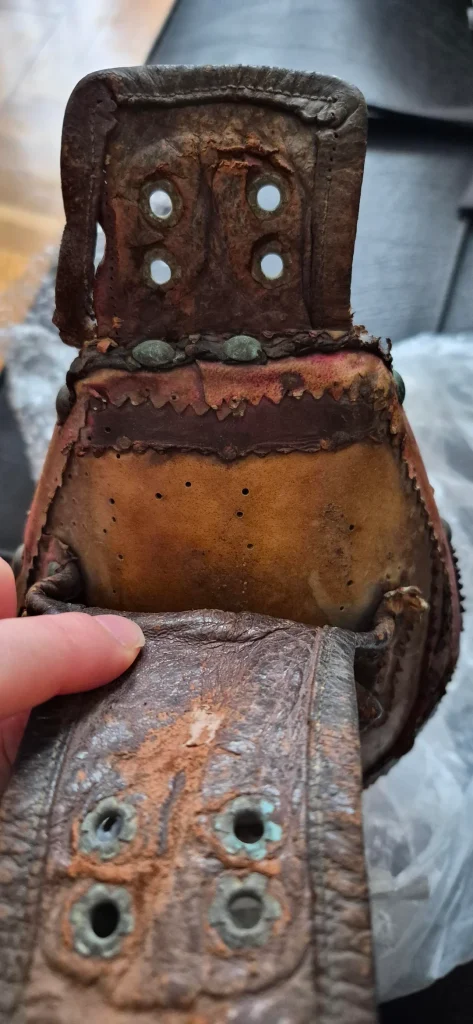
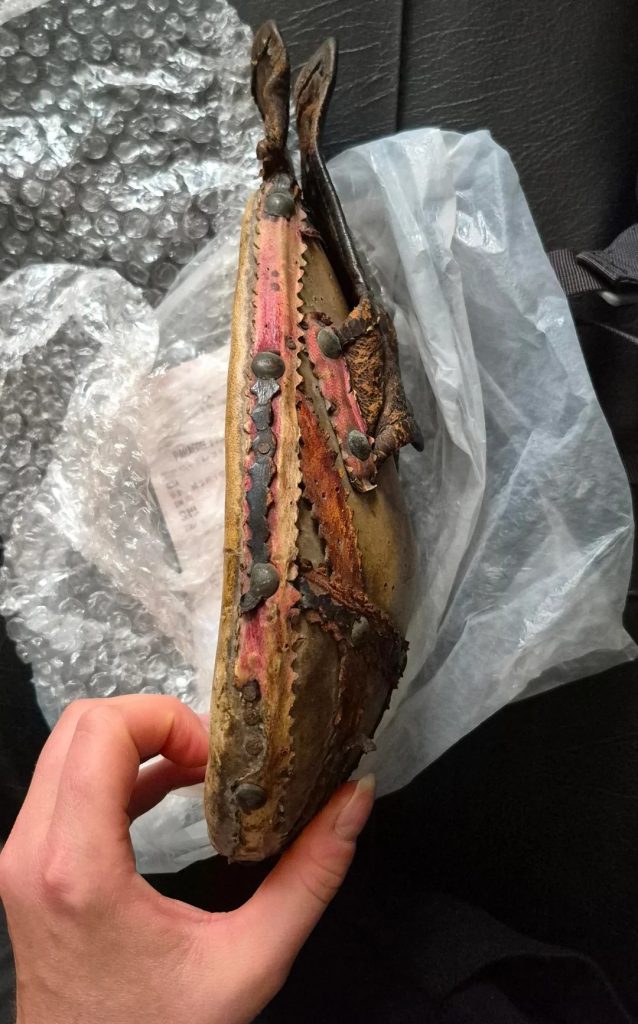
It was hidden beneath layers of age, its leather cracked and darkened by time. Tiny metal studs clung stubbornly to its surface. The stitching looked handmade. The shape was unlike anything I had ever seen.
And the more I stared at it, the more unsettling it became.
When I first saw it, I couldn’t tell whether I was looking at a forgotten tool, a ceremonial artifact, or something that had no business surviving this long.
It was hidden beneath layers of age, its leather cracked and darkened by time. Tiny metal studs clung stubbornly to its surface. The stitching looked handmade. The shape was unlike anything I had ever seen.
And the more I stared at it, the more unsettling it became.
At first glance, it looked ordinary enough—just an old object rescued from someone’s attic, garage, or storage room. But objects like these have a way of carrying stories with them. Stories that disappear when the people who knew them are gone.
The question was simple:
What was it?
But the answer proved far more mysterious.
A Discovery That Raised More Questions Than Answers
The object appeared to be made from aged leather stretched tightly over a hard frame.
Its surface was marked by tiny holes, worn edges, and rivets that suggested decades—perhaps even generations—of use.
The top section resembled a handle or strap attachment.
When I first saw it, I couldn’t tell whether I was looking at a forgotten tool, a ceremonial artifact, or something that had no business surviving this long.
It was hidden beneath layers of age, its leather cracked and darkened by time. Tiny metal studs clung stubbornly to its surface. The stitching looked handmade. The shape was unlike anything I had ever seen.
And the more I stared at it, the more unsettling it became.
At first glance, it looked ordinary enough—just an old object rescued from someone’s attic, garage, or storage room. But objects like these have a way of carrying stories with them. Stories that disappear when the people who knew them are gone.
The question was simple:
What was it?
But the answer proved far more mysterious.
A Discovery That Raised More Questions Than Answers
The object appeared to be made from aged leather stretched tightly over a hard frame.
Its surface was marked by tiny holes, worn edges, and rivets that suggested decades—perhaps even generations—of use.
The top section resembled a handle or strap attachment.
The lower section looked almost shield-like.
Nothing about it seemed modern.
And yet, nobody nearby could identify it.
Some thought it might have been part of a horse harness.
Others believed it belonged to an old musical instrument.
When I first saw it, I couldn’t tell whether I was looking at a forgotten tool, a ceremonial artifact, or something that had no business surviving this long.
It was hidden beneath layers of age, its leather cracked and darkened by time. Tiny metal studs clung stubbornly to its surface. The stitching looked handmade. The shape was unlike anything I had ever seen.
And the more I stared at it, the more unsettling it became.
At first glance, it looked ordinary enough—just an old object rescued from someone’s attic, garage, or storage room. But objects like these have a way of carrying stories with them. Stories that disappear when the people who knew them are gone.
The question was simple:
What was it?
But the answer proved far more mysterious.
A Discovery That Raised More Questions Than Answers
The object appeared to be made from aged leather stretched tightly over a hard frame.
Its surface was marked by tiny holes, worn edges, and rivets that suggested decades—perhaps even generations—of use.
The top section resembled a handle or strap attachment.
The lower section looked almost shield-like.
Nothing about it seemed modern.
And yet, nobody nearby could identify it.
Some thought it might have been part of a horse harness.
Others believed it belonged to an old musical instrument.
A few insisted it was ceremonial, perhaps carried during forgotten religious gatherings long ago.
Each theory sounded plausible.
None felt complete.
The Elderly Collector’s Warning
An elderly antique collector who examined a photograph of the object reportedly paused for a long moment before speaking.
“I’ve seen things like this before,” he said quietly.
When I first saw it, I couldn’t tell whether I was looking at a forgotten tool, a ceremonial artifact, or something that had no business surviving this long.
It was hidden beneath layers of age, its leather cracked and darkened by time. Tiny metal studs clung stubbornly to its surface. The stitching looked handmade. The shape was unlike anything I had ever seen.
And the more I stared at it, the more unsettling it became.
At first glance, it looked ordinary enough—just an old object rescued from someone’s attic, garage, or storage room. But objects like these have a way of carrying stories with them. Stories that disappear when the people who knew them are gone.
The question was simple:
What was it?
But the answer proved far more mysterious.
A Discovery That Raised More Questions Than Answers
The object appeared to be made from aged leather stretched tightly over a hard frame.
Its surface was marked by tiny holes, worn edges, and rivets that suggested decades—perhaps even generations—of use.
The top section resembled a handle or strap attachment.
The lower section looked almost shield-like.
Nothing about it seemed modern.
And yet, nobody nearby could identify it.
Some thought it might have been part of a horse harness.
Others believed it belonged to an old musical instrument.
A few insisted it was ceremonial, perhaps carried during forgotten religious gatherings long ago.
Each theory sounded plausible.
None felt complete.
The Elderly Collector’s Warning
An elderly antique collector who examined a photograph of the object reportedly paused for a long moment before speaking.
“I’ve seen things like this before,” he said quietly.
Then he leaned closer.
“But never exactly like this one.”
That comment only deepened the mystery.
According to the collector, many handmade objects from the nineteenth and early twentieth centuries were created by local craftsmen whose techniques vanished with them.
Some villages had their own unique designs.
Some families passed tools and ceremonial items from generation to generation.
Others disappeared completely, leaving behind only strange relics whose purposes became impossible to prove.
Could this be one of them?
The Forgotten Trunk
Stories like this often begin in the same way.
An old house.
A dusty attic.
A locked trunk nobody has opened in decades.
Imagine a family clearing out the belongings of a grandparent.
Inside an ancient wooden chest, buried beneath photographs and yellowed letters, sits an object no one recognizes.
No labels.
No instructions.
No explanation.
Just silence.
The object survives.
The story does not.
That is what makes discoveries like this so fascinating.
Sometimes the artifact outlives the memory of why it existed.
A Theory From the Past
One local historian offered an intriguing possibility.
He suggested the object may have been connected to travel or transportation.
During the late 1800s and early 1900s, leather craftsmen produced countless specialized items for horses, carts, wagons, and working animals.
Many were designed for very specific purposes.
Once automobiles replaced horses, these objects quickly became obsolete.
Within a generation, people forgot what many of them were for.
Today, some of those forgotten pieces appear at estate sales and flea markets, baffling even experienced collectors.
Could this be one of those lost pieces?
Perhaps.
But there was still another possibility.
The Possibility Nobody Expected
What if it wasn’t a practical object at all?
What if it had been created for a ceremony?
Throughout history, communities around the world have used handmade leather and hide-covered objects in rituals, celebrations, and cultural traditions.
Some were musical.
Some were symbolic.
Some represented status or family heritage.
When those traditions faded, the objects remained.
Without context, they became puzzles.
And puzzles have a way of capturing our imagination.
Why Objects Like This Fascinate Us
Many seniors remember a time when everyday items lasted for decades.
Things were repaired instead of replaced.
Craftsmanship mattered.
Every scratch, stitch, and worn corner told a story.
That’s why mysterious discoveries like this resonate so strongly.
They remind us that the world was once filled with objects made by human hands.
Objects built with purpose.
Objects that connected people to their work, their families, and their traditions.
Sometimes those connections survive.
Sometimes they vanish.
And sometimes all that remains is a strange object that leaves everyone guessing.
The Mystery Lives On
Even after careful examination, the true identity of this unusual artifact remains uncertain.
Perhaps it belonged to a traveler.
Perhaps it served a practical purpose long forgotten.
Or perhaps it played a role in a tradition that disappeared generations ago.
Whatever the answer may be, one thing is certain:
The object has succeeded in doing something remarkable.
It has made people stop.
Look closer.
Ask questions.
And wonder about the lives of those who came before us.
Because every mysterious artifact hides two stories:
The story of what it was.
And the story of why nobody remembers anymore.

.jpg)


.png)

.png)

.png)


.png)

0 Comment:
Post a Comment